
What does it really mean to lift someone out of poverty? Is it enough for their income to increase, for them to secure employment, or for a development programme to report that it has achieved its targets? And what happens when those improvements disappear because of inflation, climate shocks or other circumstances beyond their control?
Poverty is not simply about how much people earn or what they lack at a particular moment. It is also about the opportunities available to them, the inequalities that shape their circumstances, and the vulnerabilities that make it difficult to sustain progress.
This means reducing poverty requires more than delivering programmes with positive short-term results. It requires understanding the conditions that keep people disadvantaged and identifying what it takes to achieve lasting improvements.
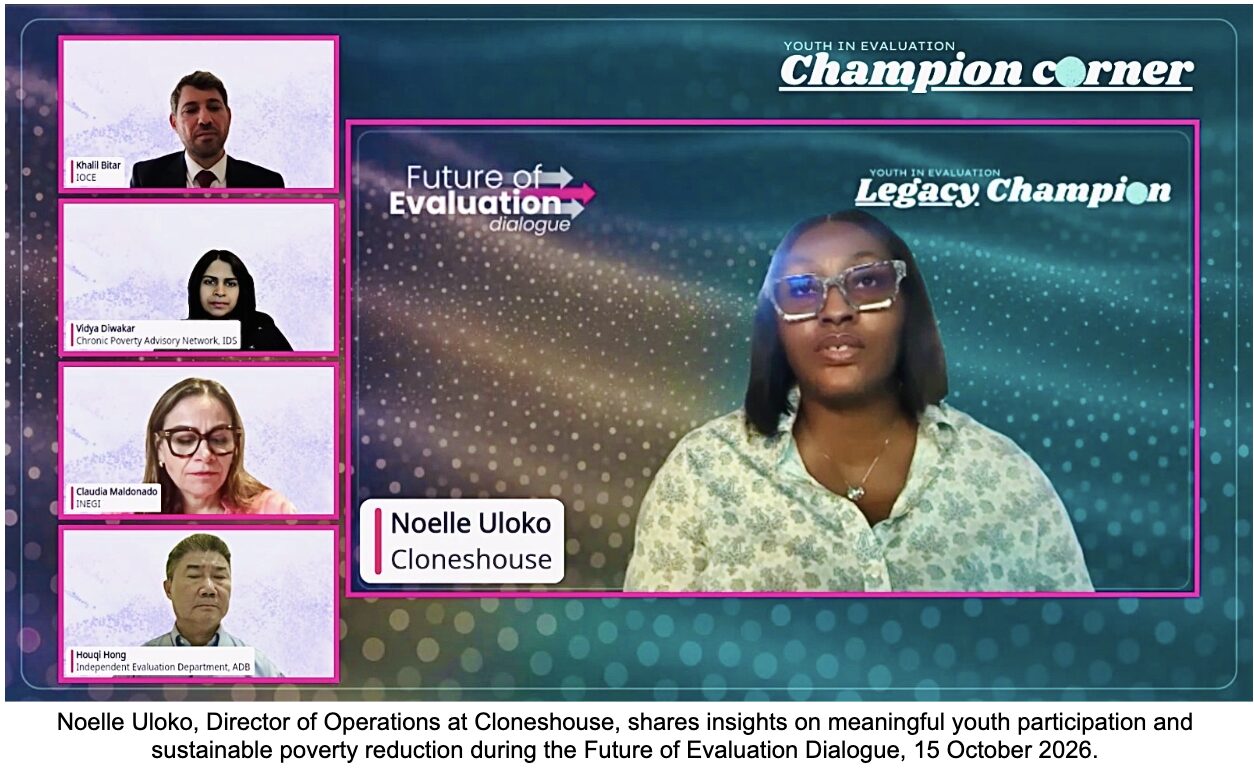
These were central questions during the Future of Evaluation Dialogue held on 15 October 2026, ahead of the International Day for the Eradication of Poverty. As a Youth in Evaluation Legacy Champion, I had the opportunity to contribute to a conversation on how evaluation can support more inclusive, resilient and sustainable solutions to poverty.
The discussion reinforced an important conviction: the value of evaluation lies not only in the evidence it produces, but also in how that evidence informs decisions and contributes to meaningful change.
Beyond Programme Outputs: What Does Success Really Mean?
In development practice, success is often communicated through numbers: people trained, jobs created, businesses supported or households reached. These indicators are important, but they do not always tell us whether people’s circumstances have improved in ways that can be sustained.
Consider a youth employment programme that successfully trains hundreds of young people. Participants may acquire valuable skills, but what happens if available jobs do not provide sufficient income to meet their basic needs? What if young entrepreneurs cannot access financing, markets or professional networks?
During a mid-term evaluation of a youth employment and entrepreneurship programme conducted by Cloneshouse , we examined this relationship between programme delivery and economic outcomes. While training activities were largely achieving their objectives, progress towards employment and business creation was more limited. Even where participants reported increased income, earnings were not always sufficient to meet basic needs. The evaluation also identified differences in outcomes between young men and women, despite relatively balanced participation.
The findings highlighted the importance of stronger employer partnerships, targeted support for young women, continued mentorship and greater attention to the wider employment and entrepreneurship ecosystem.
This experience reinforced an important lesson: providing people with skills is necessary, but may not be sufficient when the wider conditions affecting their economic security remain unchanged.
Evaluation must therefore go beyond asking whether an intervention delivered what it promised to examining whether it addressed the barriers preventing people from achieving lasting improvements.
Understanding Poverty Beyond the Numbers
Poverty is multidimensional. People’s circumstances are shaped by access to education, healthcare, decent employment, social protection and opportunities to participate in decisions affecting their lives.
A young woman in a rural community may experience economic exclusion differently from a young man in an urban area. A person with a disability may encounter barriers even where services exist. Two households with similar incomes may have very different levels of vulnerability.
These differences matter because an intervention that works for one group may not work equally well for another.
Evaluation must therefore examine how outcomes vary across populations and why. Combining quantitative evidence with qualitative research and lived experiences helps us understand not only how many people experience poverty, but also the circumstances that keep them there.
We must also recognise that poverty is dynamic. People move into and out of poverty, sometimes repeatedly. Economic instability, illness, conflict and climate shocks can reverse improvements that took years to achieve.
As evaluators, our responsibility is not simply to determine whether people have escaped poverty, but to investigate whether those improvements are sustainable and what might cause them to be reversed.
The goal is not only to understand whether people escaped poverty, but what it will take for them to remain out of it.
When Evidence Does Not Translate into Action
During the dialogue, an audience member raised an important question: if evaluation consistently identifies what works and what does not, why do we continue to encounter the same development challenges?
My response was that the gap lies in both the quality of evaluation and the willingness of institutions to act on its findings, but perhaps more significantly in how evidence is used.
We can produce technically rigorous evaluations and practical recommendations. Yet, if those findings do not influence programme design, resource allocation or policy decisions, we risk repeating the same mistakes.
Evaluation should therefore not be treated as an exercise that ends with submitting a report. It must support continuous learning, reflection and adaptation.
Institutions need to ask throughout implementation: Who is benefiting? Who is being left behind? What assumptions are proving incorrect? What emerging risks threaten sustainability? And what should we do differently?
Digital technologies and artificial intelligence can support faster analysis and more accessible evidence. However, the most important innovation is institutional: creating a culture where evidence can challenge assumptions and genuinely influence decisions.
This requires evaluators to produce credible, timely and context-sensitive findings, while institutions create the accountability and willingness needed to act on them.
Ultimately, what matters is not simply what an organisation learns from evaluation, but what it is prepared to change because of that learning.
Young People Must Have a Voice and Influence
As a Youth in Evaluation Legacy Champion, I believe young people must play a more meaningful role in shaping the evidence and decisions that affect their lives.
Too often, young people are treated primarily as programme beneficiaries or research respondents. They participate in surveys and consultations, but may have little influence over the questions being asked, how findings are interpreted or the recommendations that follow.
Yet their experiences can reveal barriers that conventional indicators overlook, from transportation costs and limited professional networks to discrimination and restricted access to decent employment.
Meaningful youth participation must go beyond consultation to influence. Young people should have opportunities to contribute to defining evaluation priorities, interpreting findings and shaping recommendations.
We must also recognise that young people are not a homogeneous group. Their experiences differ according to gender, disability, location, education and socioeconomic background. Inclusive evaluation requires deliberate efforts to engage those who are often excluded from decision-making spaces.
There is also an important distinction between involving young people whose lived experiences inform evaluation and developing young professionals who can generate and use evidence.
At Cloneshouse, initiatives such as the Cloneshouse Internship Programme provide young and emerging evaluators with mentorship, practical experience and opportunities to contribute to evaluation assignments.
We believe building the next generation of evaluators requires more than technical training. It requires creating opportunities for young people to develop professional judgement, engage with communities and contribute meaningfully to evidence-informed decisions.
We cannot continue describing young people as the future of evaluation while excluding them from opportunities to shape evaluation today.
From Evidence to Lasting Change
One statement from Claudia Maldonado during the dialogue particularly resonated with me: “There is no evaluation without measurement, but measurement is not evaluation.”
Credible measurement helps us understand the scale of poverty. But evaluation must go further by explaining the conditions behind those numbers, challenging ineffective approaches and informing solutions that respond to people’s lived realities.
For me, this requires three commitments: understanding poverty beyond immediate outcomes, strengthening institutional willingness to act on evidence, and ensuring affected communities have meaningful opportunities to influence decisions.
It also requires closing the evidence loop. Communities that contribute their experiences to evaluations should have opportunities to understand the findings, question interpretations and learn how their contributions influenced decisions.
At Cloneshouse, we believe sustainability also means strengthening the capacity of people and institutions to continue generating, questioning and using evidence beyond individual programmes and funding cycles.
Because sustainable poverty reduction is not simply about what an intervention achieves today. It is about whether people have the opportunities, support and systems required to sustain progress tomorrow.
The future of evaluation should be one where evidence does not simply describe people’s challenges, but helps shape lasting solutions with them.

About the Author
Noelle Uloko is a results-driven professional with over a decade of experience in operations management, business development and the development sector. She is a PDPro-certified practitioner with expertise in project management, organisational strengthening and operational efficiency.
As Director of Operations and Business Development Coordinator at Cloneshouse, she supports organisational growth, strengthens internal systems, oversees day-to-day operations and promotes evidence-informed decision-making. She is also actively involved in initiatives that build the capacity of young and emerging evaluators through mentorship, professional development and practical learning opportunities.
In 2026, Noelle represented Cloneshouse in receiving the Youth in Evaluation Legacy Champion recognition under the Eval4Action initiative having also received the eEmerging Champion Award in 2024 and then the Super Champion Award in 2025, acknowledging the organisation’s sustained commitment to advancing youth participation, capacity development and leadership in evaluation.




The article reinforces a critical lesson from my CIP experience: delivering activities does not automatically translate into sustainable outcomes. I agree that evaluation must influence decisions, not merely document results. However, how can institutions ensure recommendations are implemented, particularly when funding cycles, organisational priorities, and political interests conflict with long-term development goals?
Thank you, Dauda, for this thoughtful question and for reflecting on your CIP experience. I believe institutions can address this by embedding evaluation recommendations into strategic planning, budgeting, and decision-making processes, with clear responsibilities, realistic timelines, and mechanisms for tracking implementation.
While competing interests may not always be eliminated, institutions must be willing to make informed trade-offs and prioritise recommendations that contribute to sustainable outcomes. Ultimately, the true value of evaluation lies not in the recommendations produced, but in the institutional commitment to act on evidence, learn, adapt, and sustain meaningful change.
I can relate to this from lived experience. Young people are often kept as research assistants, but to grow young evaluators, organisations must be willing to let them step into the roles where that growth happens. You can’t learn it from the sidelines
Thank you for this thoughtful reflection! We agree that evaluating the quality of evaluations themselves is just as important as evaluating programmes. Making meta-evaluation a regular practice can help organisations identify gaps, strengthen methodological quality, and ensure evaluation findings remain credible and useful for learning and decision-making.