
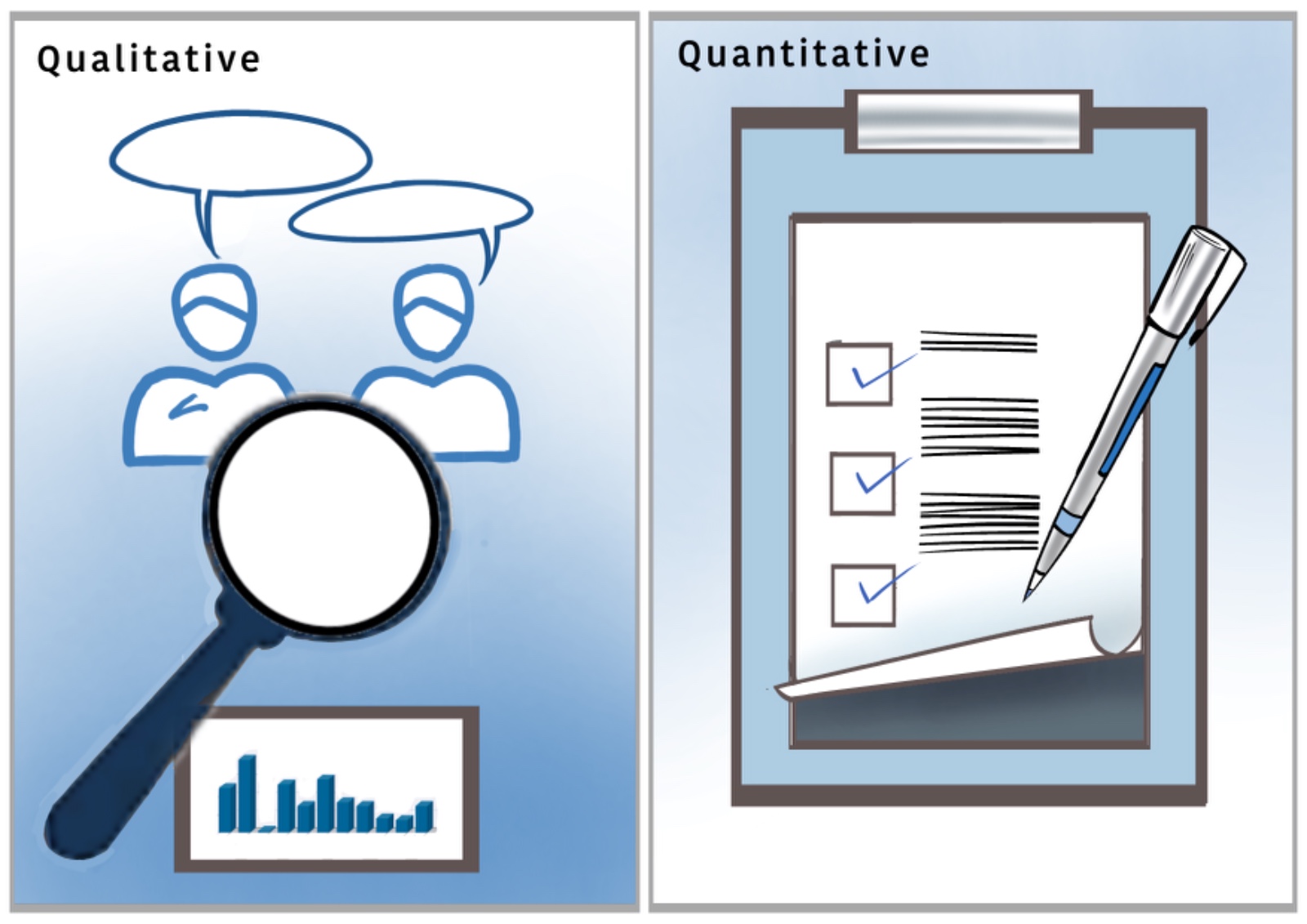
The three core mixed methods designs are convergent design, explanatory sequential design, and exploratory sequential design.
In a convergent design, the intent is to compare the quantitative and qualitative data analysis results to see how results confirm a common understanding or present diverse findings. Sometimes in this design, the qualitative data is transformed into scores or measures (data transformation). In this case, the results combination is desirable.
In an explanatory sequential design, the researcher first collects quantitative data and then follows up with qualitative data. Qualitative data serves to explain the quantitative data results in more detail. These explanations may help understand surprising quantitative responses or the quantitative statistical results in more detail.
In an exploratory sequential design, the researcher first collects qualitative data and then proceeds to develop quantitative measures that capture the understanding and culture of participants under study. The quantitative measures have to be culturally sensitive.
Although simple and beginner-friendly for research, these core designs over the years have been applied in complicated processes. For example, in project evaluation. Consequently, additional designs came into being, called complex mixed methods research designs. These complex designs include one or more core designs embedded in them.
- Mixed Methods experimental designs – the researcher adds one or more core designs into an experiment. This is accomplished by combining qualitative data with the quantitative experiment. It can be added before, during, or after the trial, or a combination of these times.
- Mixed Methods Participatory Action Research Designs – The researcher incorporates one or more core designs into an overall participatory action research process. The participatory framework becomes a constant focus of the study.
- Mixed Methods Multiple Case Study Designs – designs that include one or more core designs in a study with the intent to develop a case or multiple cases.
- Mixed Methods Evaluation Designs – designs that include one or more core designs within the stages or phases of an evaluation process. Phases in evaluation that researchers use include needs assessment, development of measures for assessing a program, design of a program, and follow-up analyses to determine whether the program works. At one or more of these stages, the researcher collects and combines qualitative and quantitative data. Consequently, the core designs are embedded into the evaluation process.
Include a worldview and a theory; the perspective that the researcher brings to the study is the worldview, while a theory is essentially a conceptual framework representing a larger explanation from the literature, typically based on other researchers’ thoughts.
Worldviews are beliefs and values that a researcher brings forth to a study that inform the type of problem under study, the methods for the problem study, and the results. (Guba, 1990).
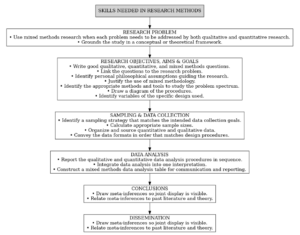
Specificity matters when describing worldviews, as researchers often have assumptions. It also enables readers to be aware of the investigator’s stance. A theory helps researchers explain study findings. A theory in quantitative research is an explanation of what the researcher expects to find. A theory in qualitative research informs the different phases in the research process. Theories inform the quantitative side of research and help determine questions to ask. They may be advanced at the beginning of the study (ethnographic) or emerge through data collection (e.g., in grounded research theory). In mixed methods studies, it is helpful to make these theories explicit, describe in detail, document the theory authors, and suggest how the theory informs a particular phase in the study. Below is a flowchart showing the various stages of a mixed-methods study;
Conclusion
Building a comprehensive set of skills to conduct mixed methods requires time. An alternative is to participate in a mixed-methods team with individuals having different skills. There is a growing presence of mixed-methods teams in academia. Members with mixed-methods skills can bridge the gap between individuals with qualitative methodological orientations and those with quantitative methodological orientations.
The core assumption of mixed methods is that when an investigator combines both qualitative and quantitative data, it provides a better understanding of the research problem than either type of data alone.
About the Author
Emmanuel Kilimo is a junior data scientist, a monitoring and evaluation intern at Cloneshouse with an affinity for driving impact in the social sector. He holds a bachelor’s degree in Economics from the University of Nairobi and a data science nanodegree. Working at the nexus of data and social impact, he is currently offering pro-bono statistical consulting with organizations such as Statistics Without Borders (SWB), Data for Social Good, and We Make Change.



This is an interesting read. I believe mixed methods is necessary to get a full picture of any research problem, but as a young evaluator still learning, going at it alone can feel daunting. Your closing point really resonates, being part of a team makes the learning curve so much easier, and lets you grow alongside people with different strengths.
I also agree with your conclusion about the value of mixed-methods teams. The collaborative approach not only eases the learning curve but also strengthens the final analysis by bringing diverse perspectives to the data. A very helpful overview for both beginners and those looking to structure more complex studies. Well done!
An informative read indeed. I agree with the conclusion that participating in teams with expertise in mixed methodologies accelerates the learning process far more effectively than trying to master them individually. From my perspective, another strength of mixed methods is that they help prevent researchers from falling prey to confirmation bias. By combining qualitative and quantitative evidence, researchers question their own assumptions rather than rely on a single perspective, ultimately leading to more robust and credible evaluations.
This is a valuable introduction to mixed methods designs that clearly explains the core approaches. However, it would be even stronger if it emphasized when and why each design is most appropriate for practical evaluations, including the trade-offs between time, cost, and evidence quality. Including a practical case study from a development or humanitarian programme would also help readers understand how mixed methods can generate actionable insights for learning and decision-making. Generally, it provides a solid foundation for beginners.
A practical overview of mixed methods research. I especially appreciate the emphasis that combining qualitative and quantitative evidence provides a deeper understanding of complex problems than either approach alone. Equally important is the reminder that researchers should clearly articulate their worldview and theoretical framework to enhance transparency and rigor. As evidence-based decision-making becomes increasingly important in research and evaluation, mixed methods remain a powerful approach for generating meaningful and actionable insights.
An insightful perspective on the future of AI in public service. The key takeaway is that AI should enhance not replace human expertise. With strong governance, transparency, data protection, and human oversight, chatbots can improve efficiency while preserving accountability and public trust.