
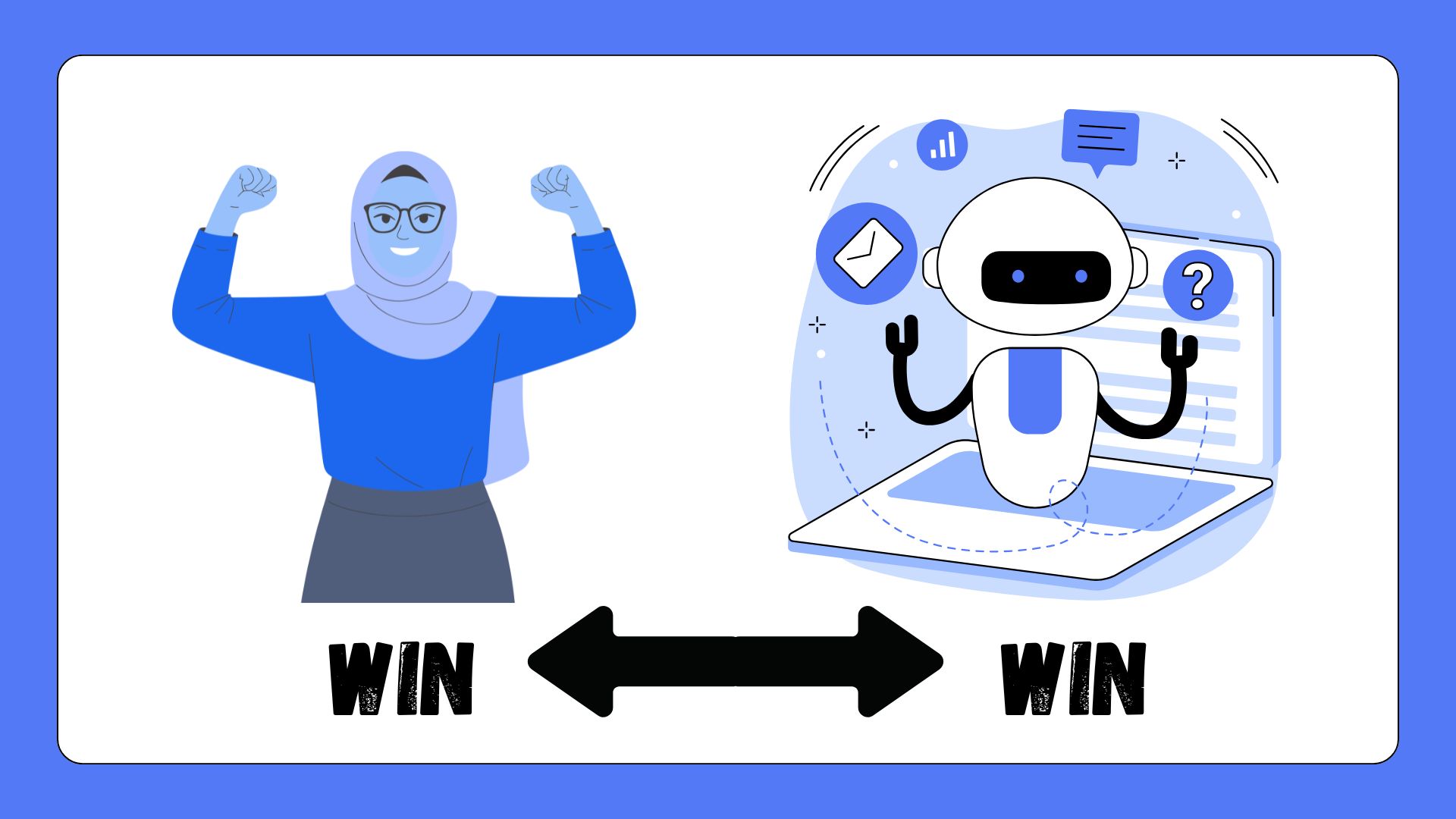
Picture Fatimah Geidam, a small business owner in Kano on a Monday morning in 2028. Instead of queuing at three separate offices, she opens a single government super-app. A chatbot guides her through bidding for a school-feeding contract, files her quarterly Value Added Tax (VAT) return, then calculates the exact duty on spare-part imports, before she finishes her tea. Now the gamechanger – all these happened in Hausa language!
From pilot to policy, that vision is moving more quickly. Nigeria’s draft National AI Strategy warns of labor displacement if deployment is not “consultative and participatory” and calls on ministries to “drive data-driven decision-making” and make public-sector datasets available for automation. On the sidelines of UNGA80 in New York, the Nigerian government recently unveiled N-ATLAS V1, the country’s open-source, multilingual, and multimodal Large Language Model (LLM).
In this article, which is a reflection of my work with Patrick Meier on Artificial Intelligence for Monitoring Nigeria Elections in 2015, I discuss three frontline revenue agencies that can swiftly take advantage of AI’s potential while outlining its benefits and drawbacks. I come to the conclusion that chatbots have the potential to boost the revenue base of Nigeria’s revenue-generating organizations and transform them—not by taking the place of civil servants, but by enabling them to perform tasks that machines cannot, such as assessing context, using judgment, and staying answerable to the people they serve.
1. Government procurement – Bureau of Public Procurement (BPP)
BPP already hosts the Nigeria Open Contracting Portal (NOCOPO), which publishes tenders and contract awards online – albeit inefficiently. Swapping front-desk officers for a large-language-model chatbot could:
Slash lead times. Vendors would get instant, standard answers on eligibility, document formats, and bid deadlines. These are tasks that consume up to 40 percent of procurement officers’ hours in some MDAs.
Spot red flags early. A well-trained bot can parse pricing patterns across thousands of contracts and flag suspicious single-bid awards for human review.
Level the playing field. Micro-suppliers outside Abuja can gain 24/7 guidance in English, Igbo or Hausa, cutting travel and lobbying costs.
Yet risks loom. Bid-evaluation often relies on nuance like scoring innovation, verifying site visits, that is hard to codify. Training data drawn from historical awards may embed the very biases reformers hope to erase. And if the bot’s decisions are opaque, losing bidders have no clear appeal path, undermining trust. Brookings research on Nigerian procurement warns that automation without radical transparency could simply “digitise discretion.”
2. Tax payment and filing – Federal Inland Revenue Service (FIRS)
FIRS (to be called Nigeria Revenue Service from January 2026) already pilots an AI-enabled help-bot that guides taxpayers through company-income-tax rules over WhatsApp and webchat. Senior officials tout AI as a route to “enhancing Nigeria’s revenue” by making compliance painless. If chatbots take over frontline service:
Compliance could rise. Real-time prompts can cut errors on TaxPro Max returns; personalised nudges can remind SMEs of filing dates and allowable deductions.
Cost-to-collect falls. Each digital interaction costs a fraction of a call-centre minute, freeing auditors for high-risk cases.
Policy feedback sharpens. Anonymised chat logs can reveal where taxpayers struggle, informing simpler legislation.
But personal tax data are among the most sensitive the state holds. The 2023 Nigeria Data Protection Act demands “responsible data collection” and strict purpose limitation for AI systems. A breach or a hallucinating bot that issues wrong penalty figures, could destroy already fragile tax morale. Moreover, 48 percent of informal-sector workers still lack reliable internet; handing the tax front-desk to AI risks deepening exclusion.
3. Import-duty payment – Nigeria Customs Service (NCS)
Customs is modernising fast: its e-Customs project promises a “world-class fully automated ICT platform,” from risk control centres to intelligent gates, and it recently rolled out AI-powered cargo scanners at key ports. An Harmonized System (HS)-classification chatbot could:
Democratise information. Importers get instant duty estimates and documentation checklists, trimming clearing times.
Cut corruption space. Price and tariff data stored centrally leave less room for on-the-spot negotiation.
Strengthen enforcement. Bots trained on seizure data can spot patterns. For example say, undervalued electronics, and route containers for inspection.
Notwithstanding, a misclassified goods can stall a shipment for weeks. Appeals mechanisms must remain human-led, and officers need authority to override the bot when commercial reality trumps code. Cyber-sabotage is another threat: an altered training set could quietly lower duties for a smuggling ring.
Cross-cutting lessons
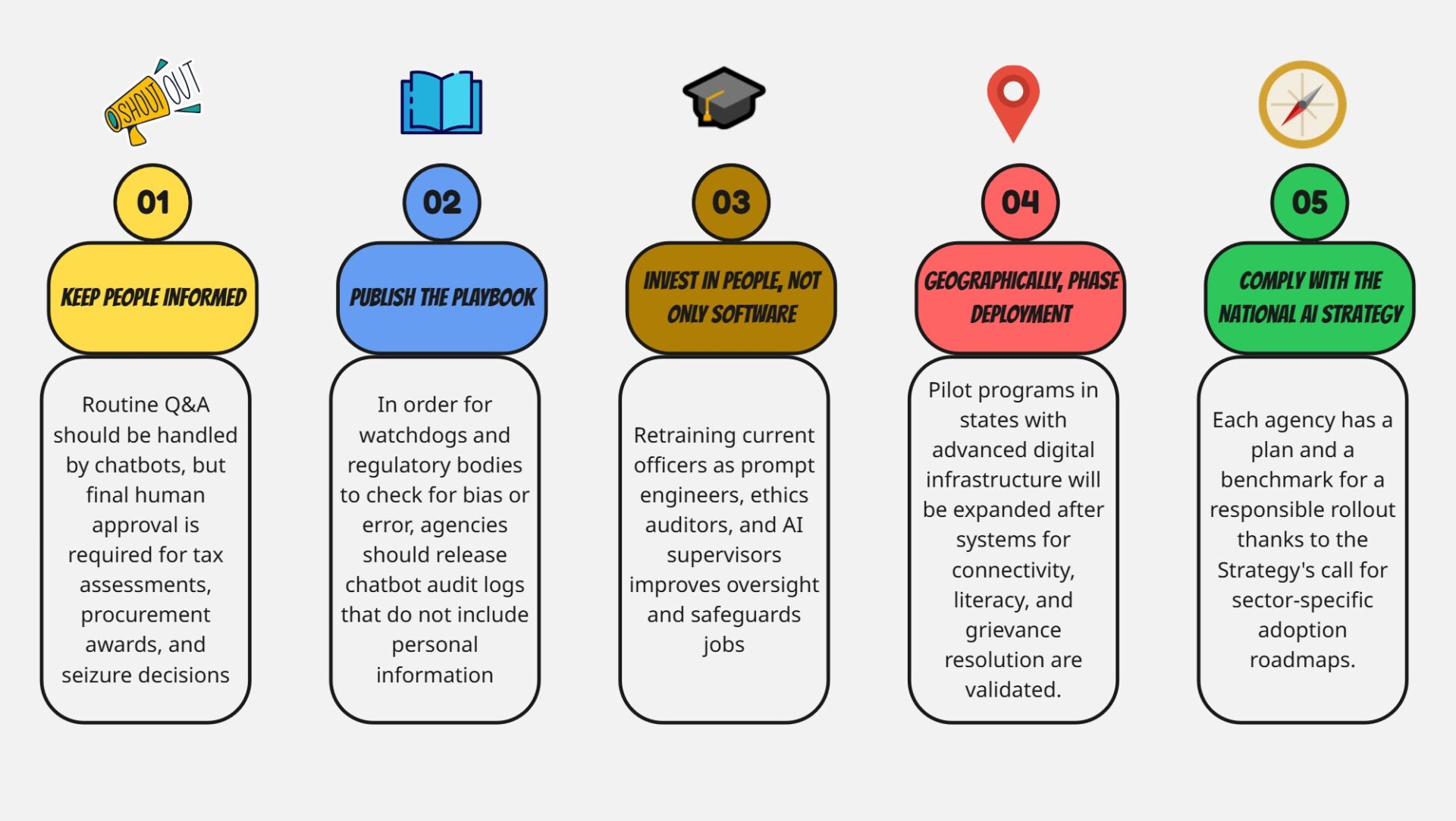
Keep people informed: Routine Q&A should be handled by chatbots, but final human approval is required for tax assessments, procurement awards, and seizure decisions.
The playbook should be published: In order for watchdogs and regulatory bodies to check for bias or error, agencies should release chatbot audit logs that do not include personal information.
Invest in people, not just software: Retraining current officers as prompt engineers, ethics auditors, and AI supervisors improves oversight and safeguards jobs.
Geographically, phase deployment: Pilot programs in states with advanced digital infrastructure (Edo, FCT, Kano, Lagos, and Rivers) will be expanded after systems for connectivity, literacy, and grievance resolution are validated.
Comply with the National AI Strategy: Each agency has a plan and a benchmark for a responsible rollout thanks to the Strategy’s call for sector-specific adoption roadmaps.
Conclusion
If Nigerians can still look a human in the eye when the algorithm makes a mistake, chatbots can make the country’s revenue-generating organizations quicker, less expensive, and more transparent. Real change will come from allowing civil servants to do what machines cannot: consider context, use judgment, and continue to answer to the people they serve. What do you think? I’d like to read your thoughts on chatbots in the Nigerian Civil Service. Feel free to use the comment box below.

I believe AI can speed things up, but I’m not sure it’s worth the risk in such sensitive areas as tax, contract bidding, and customs, especially given the data privacy, bias, and accountability concerns involved. A geographic rollout, like the article suggests, makes sense, but only once connectivity and literacy gaps are addressed first.
A balanced and insightful analysis. I particularly appreciate the core argument that the goal shouldn’t be to replace civil servants with AI, but to augment them, freeing up human judgment for the nuanced tasks machines can’t handle.
The specific examples for BPP, FIRS, and Customs are very helpful, and you’ve rightly highlighted the critical success factors: data privacy under the NDPA, the need for radical transparency to avoid ‘digitising discretion,’ and the crucial issue of the digital divide. The phased geographic rollout and the emphasis on retraining staff as AI supervisors are practical, essential recommendations.
The potential is enormous for efficiency and revenue generation, but as you’ve shown, the risks are just as significant. The real test will be in the implementation and oversight. Great read!
A balanced take on the evolving role of AI in public service indeed. My experience has shown that even well-trained AI systems can hallucinate or make incorrect recommendations. This makes human oversight indispensable, especially in sectors such as revenue collection, healthcare, and insurance, where decisions directly affect people’s lives and involve highly sensitive data.
I think AI should be introduced gradually, with humans remaining accountable for high-impact decisions. We must also ensure that its deployment is inclusive so that it does not exclude the very people it is intended to serve. For that to happen, we need to keep humans in the loop.
This is a timely and well-balanced reflection on the opportunities and risks of integrating AI chatbots into Nigeria’s civil service. The success of AI should extend beyond efficiency and cost savings to strengthen transparency, accountability, inclusion, and public trust. A robust Monitoring, Evaluation, and Learning (MEL) framework with clear performance indicators, regular user feedback, and independent evaluations can identify bias, measure outcomes, and drive continuous improvement. AI should enhance, rather than replace, human decision-making to deliver more effective and accountable public services.
Excellent analysis. I particularly appreciate the emphasis that AI should *augment* rather than replace civil servants. In high-stakes public functions such as procurement, taxation, and customs, efficiency alone cannot substitute for human judgment, accountability, and ethical decision-making.
The recommendations on human oversight, transparent audit trails, workforce reskilling, and phased implementation provide a practical roadmap for responsible AI adoption. I would only add that sustained investment in data quality, cybersecurity, and digital inclusion will be equally critical. Without reliable datasets and equitable access, AI risks reinforcing existing inequalities instead of improving public service delivery.
If implemented with strong governance, AI-powered chatbots can significantly improve service delivery, reduce administrative bottlenecks, and strengthen public trust. The ultimate measure of success will not be how many jobs AI replaces, but how effectively it empowers civil servants to deliver faster, fairer, and more citizen-centered services.