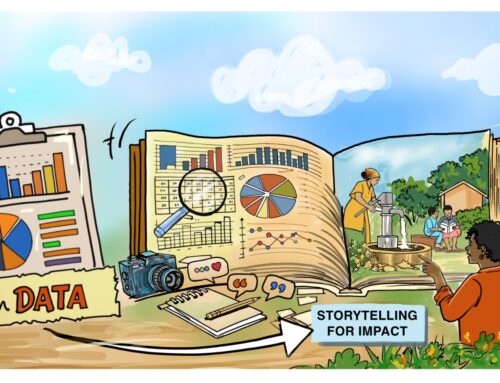

Monitoring and Evaluation (M&E) is critical for measuring and understanding the effectiveness of any program or project. It is a continuous management function to assess whether progress is being made toward expected results, to identify implementation challenges, and to determine whether there are any unintended effects, positive or negative, from a program or project and its activities. This concept, as a matter of fact, applies to our daily lives, like how we assess our performance at the end of a day to see how much we achieved against the items on our to-do list, how we try to see what went well and what we could have done better or not done at all. This reflection helps us re-strategize and prioritize our activities for better performance. In effect, we practice basic M&E every day!
This piece emphasizes the role of M&E in enhancing the sustainability of development projects. Projects designed with priority consideration for M&E are more likely to be sustainable and to achieve greater impact over time. This is credited to the fact that M&E does the following:
- M&E helps with organization: Developing M&E plans requires organizations to define project outcomes and how success will be measured, and to adapt as projects progress to achieve those outcomes. They must also develop methods to collect, analyze, and distribute data and reports to stakeholders to ensure transparency.
- M&E helps ensure resources are used efficiently: Every project needs resources. How much cash is on hand determines factors such as how many people work on a project, the project’s scope, and what solutions are available if the project goes off course. The information collected through monitoring reveals gaps or issues that require resources to address. Without M&E, it would not be clear which areas should be priorities, and resources could be mismanaged.
- Accountability and stakeholder support: By assigning roles and setting timelines, each person involved in the program’s planning and implementation is motivated to take responsibility and ownership, as they directly handle a specific aspect. They hold each other accountable for achieving set goals and are also willing to support other stakeholders to ensure the program runs smoothly.
- M and E provide for increased ownership and participation by stakeholders: Engaging program stakeholders in developing elements of the M and E system, such as the results framework and M&E plan, helps foster greater ownership and participation in the program. As a result, stakeholders are fully invested in ensuring the program’s success and continuity.
- Learning and performance improvement: While planning helps focus on results that matter, M&E facilitates learning from past successes and challenges, as well as those encountered during the implementation of current and subsequent projects. Because M&E is an iterative process involving continuous monitoring, feedback, and reflection, it enables learning and adaptation throughout implementation. As learning occurs, best practices are developed to improve performance.
- Increased donor funding: When M&E products show what is working and what is not within a program, they can encourage sustained funding, leading to success and sustainability.
- Evidence-Based Decision-Making: M&E provides a robust foundation for decision-making by offering concrete evidence of a project’s impact. This evidence-based approach empowers stakeholders to make informed decisions, allocate resources efficiently, and refine strategies for optimal sustainability.
- M&E helps organizations replicate the best projects/programs: Organizations do not want to invest time in initiatives that go nowhere or fail to meet established standards. The benefits of M&E, such as catching problems early, effective resource management, and informed decisions, all yield information that helps organizations replicate what is working and let go of what is not.
In conclusion, M&E sits at the heart of every project. Through its systems, approaches, and methods, M&E, if effective, sees that development programs are successful and sustainable.
References:
- The IDEAL Approach to Developing and Sustaining Results-Based M&E Systems in Development Projects (Barward Johnson, 2018)
- A Guide for Project M&E 2.1 An Overview of Using M&E to Manage Impact (IFAD)
- Ten Steps to Results-Based Monitoring and Evaluation System (World Bank, 2004)
- Performance Monitoring Indicator Handbook (World Bank, 1996)
- Project Planning and Management C134 Unit Ten: Monitoring and Evaluation (SOAS, 2013)
About the Author
Evelyn Ayede is a Fellow of the Friedrich Ebert Stiftung (FES) Open Minds Young Voices (OMYV) Programme and was an intern with the Cloneshouse African Internship Programme (CAIP). She is an ardent social change agent who seeks opportunities to contribute to national development through public leadership and civic engagement. She has a strong interest in developing and managing development projects, with a priority focus on monitoring and evaluation for sustainability, and is currently a Programs Officer at Quality Education Development Associates.