
Nigeria’s agribusiness opportunity is often described as “huge.” Investors already know that. The harder question is where to place capital so it converts into reliable volumes, repeat demand, and scalable unit economics. The quickest way to answer that is to follow the farmer, follow the seed, follow the dry season, and finally follow the portion of harvest that truly becomes market supply.
In this post, with the Evidence and Intelligence team at Cloneshouse, we created six charts from the Nigeria National Agricultural Sample Survey (NASS) (2022/2023) metadata, and turned it into a practical investment map for four strategic crops: Beans (also refered to as Cowpea in this piece), Cassava, Maize, and Rice. Each section names the states to prioritize, and each ends with a clear takeaway you can act on – if you are looking to invest in any of those staple in Nigeria.
Before diving in, it is worth clarifying the coverage of the data behind these charts. The analysis is based on responses from 152,485 households, drawn from an estimated 49.5 million households in Nigeria (National Bureau of Statistics, Q4 2025 figures). The survey design sampled 80 enumeration areas per Local Government Area (LGA) and 10 households per enumeration area.
Chart 1 : Where the biggest grower markets are

The four-map panel is your starting compass. It shows where the grower base is thick enough to support distribution scale, aggregation networks, and service platforms. When a state lights up, it is telling you that customer acquisition is easier, logistics routes are worth building, and partnerships with cooperatives and local buyers can reach meaningful volume quickly.
For Beans (Cowpea), the strongest concentration sits across the north, with a clear cluster around Kano and its surrounding belt, including Jigawa and Bauchi. These are your first stops if you are building seed distribution, trader networks, or a credit product tied to grain movement.
Cassava behaves differently. The cassava map is most compelling in the middle belt and south, with Benue standing out as the anchor state. If you invest in cassava processing, starch, flour, or ethanol supply chains, Benue is the natural starting point, then you extend into the surrounding corridor where cassava is widely grown.
Maize shows a broad footprint, but the biggest practical investable markets appear in the north and north central corridor, with Kaduna and Kano prominent and strong support in Niger and Benue. That corridor is ideal for input bundles, mechanization services, and aggregation models that need scale quickly.
Rice shows a familiar concentration in the north and parts of the middle belt. The map points you toward Kano, Kaduna, Niger, and the north-western production corridor where rice has enough grower density to sustain large procurement programs and milling expansion.
Key takeaway
If you are building a nationwide business, start where the grower base is densest. For Beans (cowpea) and rice, begin in Kano, Kaduna, Jigawa, Bauchi, and Niger. For maize, begin in Kaduna, Kano, Niger, and Benue. For cassava, begin in Benue and expand outward.
Chart 2 : Where modern seed adoption is already real
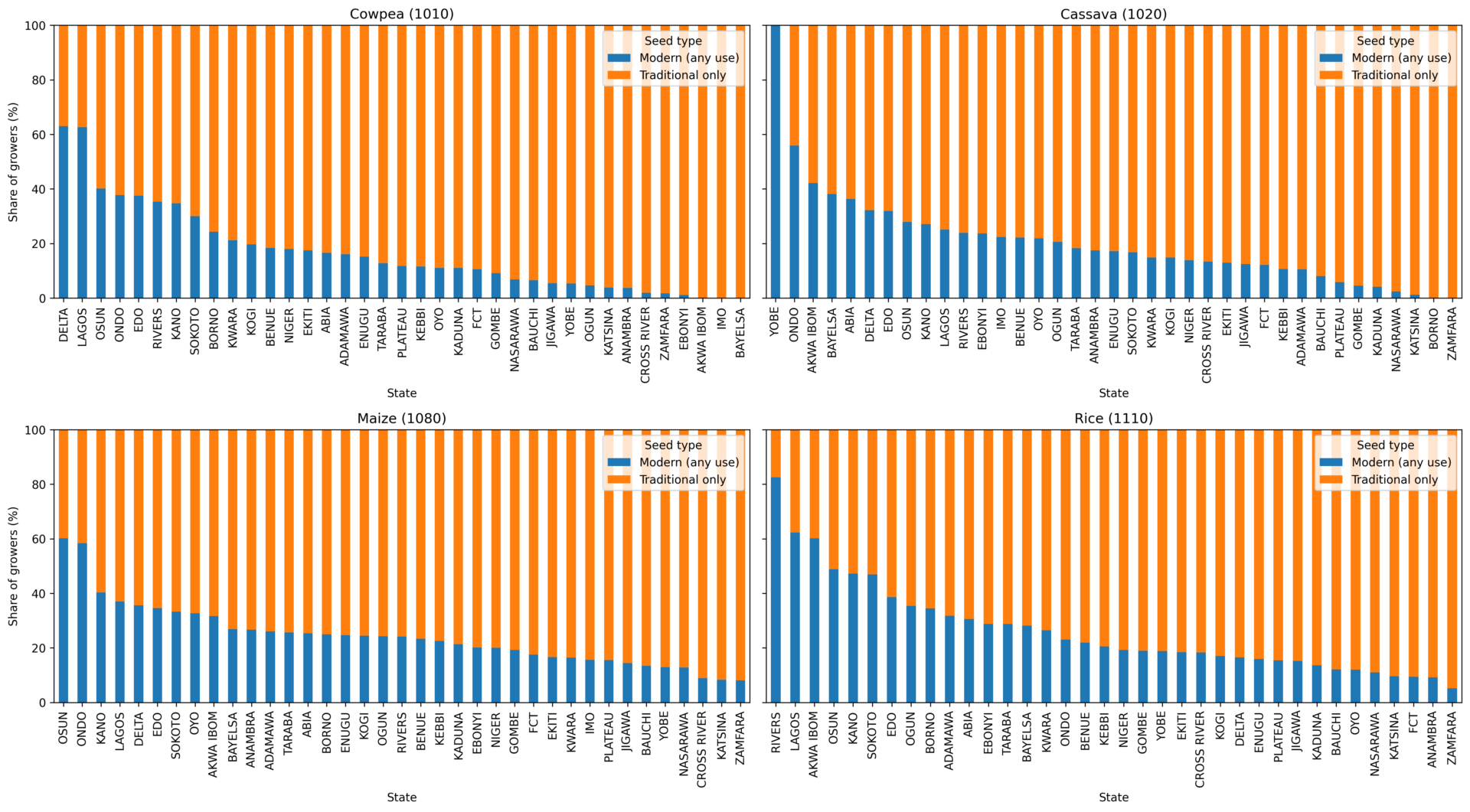
The modern versus traditional seed charts reveal something investors often underestimate: the same product strategy will not work everywhere. Modern seed adoption is not only about farmer awareness. It reflects the presence of functioning input markets, the credibility of supply chains, and whether farmers have seen payoffs from improved varieties.
For Beans (cowpea), the highest modern-seed use shows up in a small set of states that have learned the modern seed habit. Delta and Lagos sit at the top, followed by states like Osun and Ondo. These are the places where a seed company can compete on brand, availability, and dealer execution rather than pure demand creation.
For Maize, modern seed adoption is strongest in Osun and Ondo, with Kano and Lagos also showing meaningful uptake. These are attractive for seed players because repeat purchase cycles are more likely and demonstration effects spread quickly.
For Rice, modern adoption is strongest in Rivers and Lagos and remains strong across several southern and middle belt states. That matters because rice seed and rice systems often require complementary inputs and more structured extension. Where modern uptake is already high, bundled offers and credit-linked input packages become easier to scale.
Cassava is a special case because “seed” is planting material and often moves through informal channels. The cassava panel still helps you find where formal or modern planting material is gaining traction. States like Yobe and Ondo stand out on the adoption side, with Akwa Ibom and Bayelsa also appearing high. That is useful for investors exploring improved stems, multiplication networks, or nucleus-outgrower planting material models.
Key takeaway
For rapid commercial scale, target states where modern seed is already a habit. For cowpea, prioritize Delta, Lagos, Osun, and Ondo. For maize, prioritize Osun, Ondo, Kano, and Lagos. For rice, prioritize Rivers, Lagos, and the southern belt where adoption is visibly higher.
Chart 3 : Where farmers actually buy seed, and where seed companies can win

Chart 2 tells you whether modern seed is used. Chart 3 tells you the routes through which seed moves. This is where your route-to-market strategy either becomes obvious or dangerously wrong.
The seed-source mix is dominated by own-saved seed and local markets in many states, which means the fastest growth for formal seed companies comes from two types of states. The first group is where seed companies already have visible share, so distribution and brand-building can scale quickly. The second group is where local markets dominate but demand is high, so formal seed can enter through trusted dealers and small pack sizes.
The chart above highlights the top states by “seed company” share for each crop, thus providing us with a shortlist of states where formal seed channels are most investable.
For Beans (cowpea), the leading states to prioritize include Osun, Delta, Lagos, Kano, Kogi, Kaduna, Oyo, Sokoto, Bauchi, Plateau, Rivers, Nasarawa, FCT, Benue, and Yobe. These are the states where seed companies are already part of the seed story, and where expanding dealer density can translate into sales.
For Cassava planting material, the top states include Kano, Osun, Oyo, Kogi, Ondo, Abia, Ogun, Akwa Ibom, Bayelsa, Niger, FCT, Rivers, Delta, Enugu, and Plateau. If you are building multiplication farms, certified stem distribution, or a processor-led planting material program, these states are your best early targets.
For Maize, the top states include Osun, Oyo, Kano, Kaduna, Kogi, Enugu, Bauchi, Yobe, Ondo, Katsina, Delta, Zamfara, Sokoto, Nasarawa, and Lagos. That list reads like a practical map for seed company expansion and dealer network build-out.
For Rice, the top states include Lagos, Akwa Ibom, Osun, Bayelsa, Abia, Rivers, Ogun, Kano, Kogi, Kwara, Katsina, Bauchi, Ekiti, Kaduna, and Yobe. If you are investing in rice seed systems or contract-linked seed supply, this list matters because it aligns with places where formal channels already appear.
Key takeaway
Invest in distribution where formal seed is already present, then expand outward. The states listed above are the strongest starting points for seed-company growth by crop because the channel already exists and can be strengthened quickly.
Chart 4 : Dry-season seed demand hotspots for Rice and Beans (Cowpea)
Dry season is where margins often rise, because supply is tighter and prices can be better. But dry season is also where investment fails if it chases assumptions rather than evidence. The dry-season heatmap shows where farmers are actually seeding rice and beans (cowpea) in the dry season, using average seed per seeded household. The heatmap masks cells where conversion is unreliable, thus keeping the signal clean for hotspots only.
For Beans, Ogun stands out as the strongest hotspot in the dry season pattern. That is a powerful message for investors interested in dry-season input packages, short-cycle legume finance products, or off-season aggregation plays. It suggests that in Ogun, cowpea dry-season activity is not theoretical, it is visible in the data.
For Rice, Kwara appears as the clearest dry-season hotspot. Delta is also visibly strong on the rice side. Those states are natural candidates for irrigation-adjacent services, dry-season seed positioning, and contract procurement pilots designed to smooth mill supply outside the main harvest window.
Key takeaway
Dry-season strategies should start where dry-season behaviour already exists. For rice, prioritize Kwara and Delta. For cowpea, prioritize Ogun, and treat it as a dry-season legume hub worth deeper market development.
Chart 5 : Area versus yield, the investor’s upgrade map

This chart (showing only for Rice) is the most investor-friendly one because it separates volume from productivity. A state can have a large area but weak productivity, which signals upgrade potential. Another state can have high productivity but small area, which signals expansion potential. The annotated quadrant summaries already name the states for each role.
For Beans (cowpea), the biggest area states are Yobe, Niger, and Bauchi. The highest-yield states include Akwa Ibom, Anambra, and Delta. The supply hubs, meaning states that combine meaningful area and strong yield, include Kaduna, Sokoto, Kogi, Gombe, and Kwara. The upgrade targets, meaning high area but lower yield, include Yobe, Niger, Bauchi, Taraba, and Kano. The expansion candidates, meaning high yield but low area, include Akwa Ibom, Anambra, Delta, Abia, and Osun.
For Maize, the biggest area states are Taraba, Kaduna, and Niger. The highest-yield states include Anambra, Ekiti, Sokoto, Lagos, and Rivers. The supply hubs include Oyo, Kogi, Kebbi, Edo, and Ogun. The upgrade targets include Taraba, Kaduna, Niger, Kano, and Adamawa. The expansion candidates include Anambra, Ekiti, Sokoto, Lagos, and Rivers.
For Rice, the biggest area states are Kano, Taraba, and Niger. The highest-yield states include Ogun, Anambra, Lagos, Delta, and Edo. The supply hubs include Kaduna, Kebbi, Cross River, Kwara, and Sokoto. The upgrade targets include Kano, Taraba, Niger, Bauchi, and Nasarawa. The expansion candidates include Ogun, Anambra, Lagos, Delta, and Edo.
Key takeaways
If you want the highest return on productivity investment, focus on the upgrade targets. For rice, that means Kano, Taraba, Niger, Bauchi, and Nasarawa. For maize, that means Taraba, Kaduna, Niger, Kano, and Adamawa. For cowpea, that means Yobe, Niger, Bauchi, Taraba, and Kano. If you want reliable procurement and processing supply, focus on the supply hubs listed above.
Chart 6: Market surplus, the reality check for trading and processing
This final chart answers the question investors sometimes forget to ask. How much of what is harvested actually enters the market?
Nationally, rice and maize show the strongest marketed orientation. In both crops, sold shares sit above half of the accounted harvest, while consumption takes a smaller but still meaningful portion. Beans (cowpea) sells strongly too, but consumption takes a larger share compared to maize and rice, reflecting its role in household food security.
The implications are practical. Rice and maize offer a clearer path for scaling procurement and processing because a larger share of harvest becomes tradable volume. Beans remains highly investable, especially for trading, storage, and structured aggregation, but investors should expect stronger competition with household consumption and gifting practices, particularly in states where beans is a staple and not just a cash crop.
Losses during harvest appear relatively small in the national shares, which is encouraging, but it does not mean post-harvest is solved. It means losses captured at this stage are not dominating the accounted use. Storage, drying, and logistics investments can still unlock value, especially when combined with strong marketed surplus states identified earlier.
key takeaways
If your interest is in production volume, rice and maize have the cleanest marketed-surplus profile nationally. Cowpea is still attractive, but your model should account for a larger share staying within households through consumption and informal flows.
The investor’s shortlist, turned into an action map
When you combine all six charts, a coherent investment map emerges.
For Rice, Kano, Kaduna, Niger, Taraba, Kebbi, Kwara, and Sokoto repeatedly appear as volume, hub, or upgrade states, while Lagos and Ogun also matter as high-yield or strong-channel states depending on the layer you are investing in.
For Maize, Taraba, Kaduna, Niger, Kano, Oyo, and Kogi anchor the volume and hub story, while Anambra, Ekiti, Lagos, and Rivers stand out where productivity is strong and expansion models can work.
For Beans (cowpea), Kano, Jigawa, Bauchi, Niger, and Yobe define the large grower and upgrade corridor, while Kaduna, Sokoto, Kogi, and Kwara show up as supply hubs, and Delta and Lagos signal places where modern seed behaviours can be leveraged commercially.
For Cassava, Benue remains the anchor market state from the grower map, and the seed-channel chart highlights a practical cluster for planting material investments including Ogun, Ondo, Kogi, Osun, Oyo, Abia, Rivers, Delta, Enugu, and Akwa Ibom.
If you are an investor choosing where to place capital, these charts do not just describe Nigeria’s agribusiness landscape. They point to where a business can scale fastest, where productivity programs can generate the biggest lift, and where marketed surplus is strong enough to justify real procurement and processing capacity, albeit some nuanced challenges.
If you work in Nigeria’s agribusiness ecosystem, I’d love to hear how these six charts compare with what you’re seeing on the ground. Which states do you think are the most investable right now for rice, maize, cassava, or cowpea, and what’s the one constraint you believe matters most there: seed quality, irrigation, insecurity, finance, logistics, or market access? Share your picks and your reasoning in the comments, and if you’re comfortable, mention the type of business you’re building or investing in so others can learn from the pattern.