Conventionally, monitoring and evaluation of development programs have been done using quantitative performance indicators only. In the concept of development, the approaches and strategies used to implement development programs also changed. There is now an increasing demand for alternative or supplementary M&E approaches that not only meet needs for accountability but also help identify and value diverse impacts of programs.
Have you been overwhelmed by a multitude of numbers, figures, and tables without really knowing what the data means? This is undoubtedly visible in a context where projects mainly collect numerical data that doesn’t capture change. This is where the art and science of data storytelling come into play.
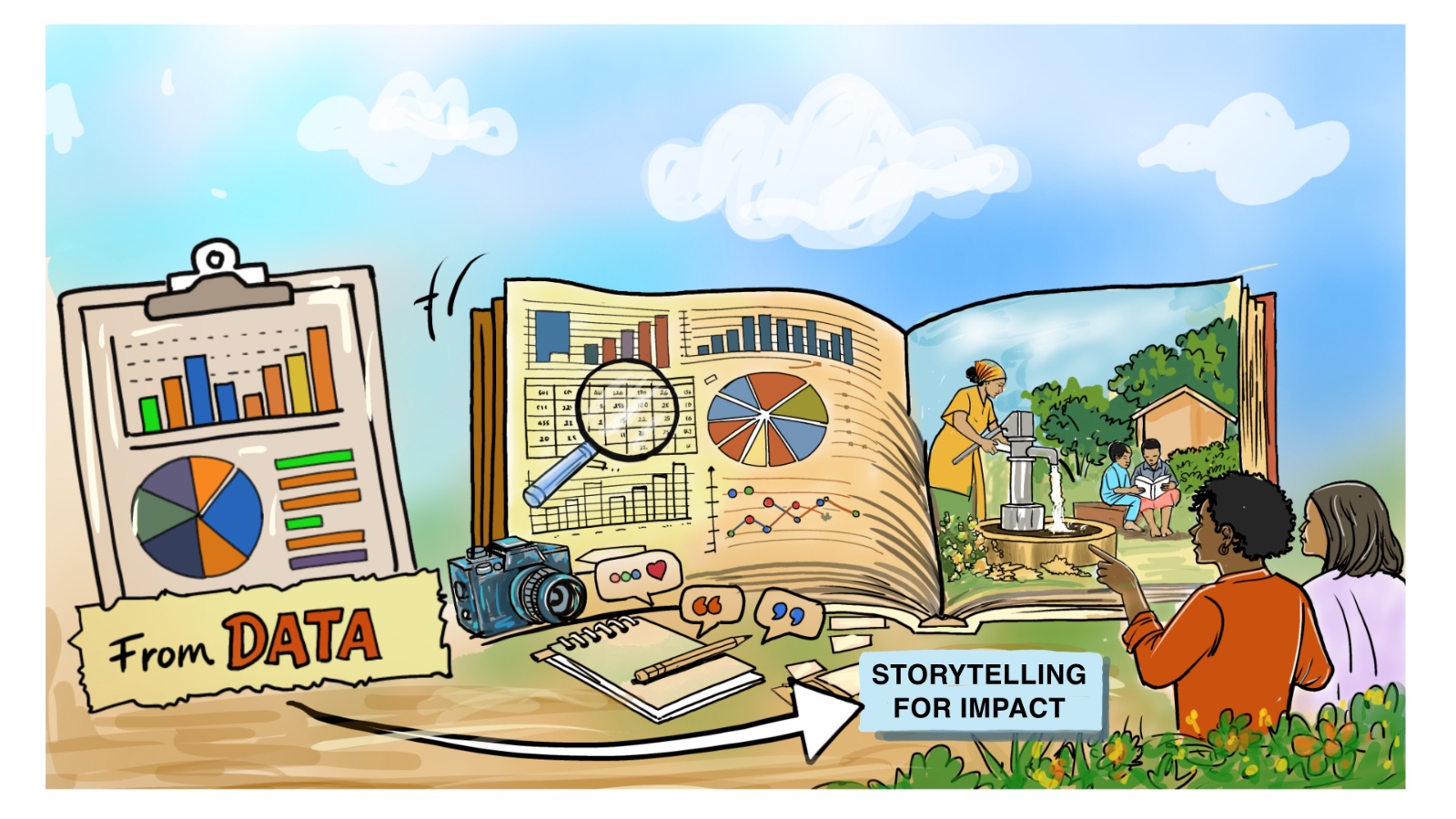
Data storytelling is a methodology that combines data, narrative, and visualizations in a structured manner to communicate information more effectively. Transforming data into compelling narratives is essential for effectively communicating the impact of development projects. This method transforms raw data into a story that not only informs but also inspires action. This blog aims to showcase how storytelling can enhance the impact of a program or project through M&E findings
Development is not always visible like a plant growing under the surface of the ground; a great deal may be happening that is not readily apparent. We need to develop the capacities to access and understand this movement to have a full understanding of the processes at work, be it in preparation for an intervention, or as part of a process of understanding its impact (Soal, Sue, 2001).
Some changes induced through social development are easy to understand and measure, and it is often possible to use quantitative indicators to capture change. However, some kinds of change may be too complex to measure directly. In these situations, case studies or stories of change are often used as alternatives or supplements to quantitative reporting.
- The importance of stories of change
When used as an evaluation tool, stories can help reveal program impacts that are considered desirable or undesirable by beneficiaries and other program stakeholders. Stories of change are always focused on change and attempt to show how a project or program has contributed to change within the lives of its targeted beneficiaries, or to other forms of change, such as policy or organizational change (International NGO Training and Research Centre (INTRAC, 2017). It may be used to communicate specific concepts or ideas to different stakeholders. And it may be used to make reports to donors or governments more readable, and by the way, to show the ‘human face’ behind statistics and broad statements.
While data provides the framework, it’s the human stories embedded within those numbers that truly resonate with the audience. Finding human connections within data helps development practitioners move beyond simple statistics and create stories that have a lasting impact, building trust and credibility, and for advocacy and fundraising.
- Components of effective stories of change
While there’s no definitive, universally agreed-upon framework for the components of effective data storytelling, several key elements consistently emerge in research and practice. Each plays a distinct role in transforming raw data into a compelling story that not only informs but also engages and persuades its audience. These elements are:
- Data Foundation
Accurate, reliable, and relevant data is the cornerstone of any effective story. Data must be carefully selected to support the narrative, ensuring that the story is grounded in facts that are both pertinent and compelling. Data selectivity is also important in order to extract meaningful insights and avoid information overload. Different methods of data collection can be used to develop stories of change.
- Compelling Narrative
A well-structured narrative is what transforms a collection of data into a story. The narrative should have a clear beginning that introduces the topic and its importance, a middle that presents the data in a meaningful context, and an end that summarizes the insights and suggests actions or conclusions. The narrative connects the data, providing context that turns numbers into insights. It helps the audience understand why the data matters and guides them through the logical progression of the story.
- Visualizations
Visual elements such as charts, graphs, and infographics play a critical role in making data accessible for audiences. They translate complex datasets into visual formats that can be easily understood. Beyond accessibility, visualizations make the story engaging.
- Challenges and How to Overcome Them:
While data storytelling is a powerful tool for communication and decision-making, it comes with its own set of challenges. Addressing these effectively can significantly enhance the quality and impact of the story. Some common challenges can be:
- Data Complexity: Dealing with large and complex datasets can be overwhelming.
- Audience Understanding: Creating stories for different audiences with varying levels of data literacy.
- Ethical Considerations: Ensuring data privacy, accuracy, and fairness.
- Time Constraints: Conclude the need for compelling storytelling with project deadlines.
Some Practical Solutions:
To meet these challenges, the following solutions can be adopted:
- Data Simplification: Use clear and concise language, focus on key findings, and break down complex data into digestible chunks.
- Audience Segmentation: Create stories for different audiences, using appropriate language and visuals.
- Ethical Guidelines: Adhere to data protection regulations, obtain necessary permissions, and be transparent about data sources.
- Time Management: Prioritize tasks, allocate sufficient time for storytelling, and use existing resources.
Conclusion
By effectively combining data, narrative, and visuals, M&E professionals can create compelling stories that resonate with audiences and drive meaningful change. By shifting the focus from simple data analysis to human-centered storytelling, we can unlock the full potential of M&E to inform, inspire, and advocate for development initiatives.
By investing time and effort in crafting compelling narratives, we can transform complex data into powerful tools for change. Let’s move beyond numbers and create a future where data-driven stories inspire action and drive sustainable development.
REFERENCES:
- Case studies and stories of change: INTRAC, 2017; Email: info@intrac.org
- Editha Cagasan; Ma. Theresa H. Velasco: Using stories of change to monitor and evaluate impacts of the Techno Gabay Program in Eastern Visayas, Philippines. January 2009; The Journal of Development Communication 1(2):31-72.
- Michael Bamberger; Vijayendra Rao; Michael Woolcock: Using Mixed Methods in Monitoring and Evaluation; Experiences from International Development. The World Bank Development Research Group Poverty and Inequality Team, March 2010.
Soal, Sue. (2001). Measuring Development – Holding Infinity. A writing from the Community Development Resource Association’s Annual Report 2000/2001.
About the Author:
Sitan Konare is a Cloneshouse Internship Programme Alumnus and a research and learning professional from Mali with a background in Agricultural Economics. She has experience across monitoring, evaluation and learning, research, project supervision, data collection, and community development.
She is passionate about strengthening organizational learning cultures and promoting the use of data to drive sustainable development and meaningful change.